


Ice Quality
Ice quality is where every conversation about REALice starts
Cold treated water sounds like a compromise. It isn't. Ice made with REALice is harder, clearer and makes less snow than ice made with hot water, and the operators who were most skeptical are now the ones saying so. Below is what has been measured, what operators say, what the official reports record, and where they all agree.
Harder, and more even across the rink
Southern California Edison tested ice hardness before and after REALice at two rinks, San Miguel and Anacapa, using a Schmidt hammer at fixed points across each sheet. Their conclusion: the readings were as good or better after REALice at both rinks, and the ice was much more uniform in hardness from one end to the other.
What the readings showed. Rebound readings rose after the change, and the report's conclusion is that the ice was harder on average at both rinks, with “the overall uniformity of ice strength… much better after the installation of the Realice system.”
How to read that. A Schmidt hammer is a comparative tool on a surface as soft as ice: it tells you whether one sheet rebounds harder than another, not how strong the ice is in absolute terms. The reliable takeaway is the direction and the consistency: harder, and the same hardness everywhere on the sheet.
Southern California Edison, Design & Engineering Services, Ice Rink Water Treatment System Assessment ET09SCE1070, December 2010
"We have huge savings and having great ice. Even some of the pro teams skating in our facility are saying how hard it is. There is nothing I would want to change."
Chet Murch, former General Manager, The Rinks at Exeter, NH"I was the biggest skeptic, being an old-school ice maker, but I can eat crow now."
Mike Shevallier, Arena Manager, Christenson Sports & Wellness Centre, Rocky Mountain House, ABClearer, because the air is gone
Untreated water carries micro-bubbles into the ice, which scatter light and turn the sheet milky. REALice removes them before the water hits the ice. Same rink, same lighting, same camera position: the only change between these two photos is the water.
"First thing we saw is just the clear ice. The lines show up. Easier for the referees, easier for the scorekeeper."
Twin Rinks, Tacoma, WA (from Tacoma Power's video on the installation)"Some of our operators were really worried about the ice quality we'd get by using cold water to flood the ice. If there had been a difference, I would have heard about it from everyone. With the REALice system, we're not missing a beat."
Ange Tassone, former Supervisor of Facility Operations, City of Guelph

Want to see it on your own ice? Tell us about your rink and we'll prepare a savings estimate and walk you through what to expect from the first flood.
Get a free rink estimateLess snow, and a sheet that holds up all day
This is the change operators mention first. Denser ice sheds less material under skates, so there's less snow to scrape and what comes off is a fine powder rather than slush. The sheet stays flat and hard through a full day of bookings instead of breaking down by the evening.
Kitchener's blind test. After a 12-month pilot at Sportsworld Arena, the City of Kitchener asked user groups about the ice without telling them anything had changed. Figure skaters noticed a smoother glide, public skaters reported better consistency, and the hockey academy reported faster pucks and quicker rut recovery.
City of Kitchener, 12-month REALice pilot, Sportsworld Arena. Webinar recap
Lake Placid. Since switching to REALice, Mount Van Hoevenberg has seen 12 new speed skating track records and multiple world records, with a 90% approval rating from skaters.
Hear it from the operators and skaters
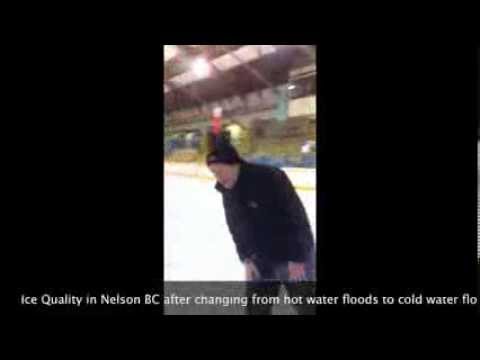
Short clips from four BC arenas on what changed on the ice.



What the official reports say
Operators tell us the ice is good and we would say so either way. These are the people with no stake in it: the municipalities' own energy reports and the provincial agency that paid the rebates, describing the ice in their own documents.
Mississauga said it with the numbers. The City's Energy Management group measured the Erin Mills Twin Arena against the same months a year earlier and recorded ice plant electricity down 20% and demand down 37.5 kW — and reported that result, in its own words, “with no change in the ice quality for the users.”
City of Mississauga, Facilities & Property Management. Erin Mills Twin Arena report (PDF)
St. Albert, on the brine reset. Alberta's funding agency lists the key action as resurfacing with 4°C water instead of 52°C, which reduces the load on the compressors and lets the brine temperature warm several degrees — “all while maintaining ice quality.” The REALice retrofit at Servus Credit Union Place paid back in a year; the City went on to plan a second system.
Municipal Climate Change Action Centre. REALice retrofit story · case study (PDF)
"Known for having some of Alberta's best ice… hard, durable, and fast ice surfaces that set quickly after each flood and can withstand heavy tournament use."
Municipal Climate Change Action Centre, on the Multi-Rec Centre, Slave Lake, ABSlave Lake. The agency's case study is titled “The best ice in Alberta?” and credits REALice with creating “a flawless, glassy surface”. The test it describes is the Treaty 8 Cup: a tournament weekend where the sheet has to stay fast, smooth and durable from the first game to the last.
Municipal Climate Change Action Centre. Slave Lake case study (PDF)
Foothills County. Among the outcomes the agency records for the Scott Seaman Sports Rink, alongside the energy and emissions figures: improved ice quality and occupant comfort, with reduced maintenance.
Municipal Climate Change Action Centre. Foothills County case study (PDF)
Why the ice is different
Ice crystals from untreated water and REALice-treated water were compared under cross-polarized light, with the imaging done at Luleå University of Technology. The REALice crystals were larger and more homogeneous, giving ice that is more consistent across the sheet. The report was written by the manufacturer, Watreco.
Separately, the Polymer Technology Group at Eindhoven University of Technology measured the treated water itself: viscosity 3–17% lower and heat capacity about 5% higher, one of the reasons the refrigeration plant has less work to do.
The treatment itself changes the water before it freezes: lower viscosity and no entrained air. How the technology works →

Read the studies
- Ice hardness testing (PDF)Southern California Edison. Schmidt hammer results at two rinks, before and after REALice.
- Ice crystal comparison (PDF)Crystal structure of REALice ice. Imaging at Luleå University of Technology; report published by the manufacturer.
- FortisBC rink pilot (PDF)Ice quality rated equal or better at all ten rinks, with ice carried 0.25–0.5 inch thinner.
- City of Mississauga, Erin Mills (PDF)The City’s own real-time data: plant electricity down 20%, with no change in ice quality for users.
- Slave Lake case study (PDF)Alberta’s funding agency on a rink known for some of the best ice in the province.
- Ice quality assessment guide (PDF)How to get the most from REALice ice: thickness, temperature and flooding practice.
All measured results, with method and source →
Further reading in the Ice Academy: optimal ice thickness, optimal ice temperature and the importance of wash water.
See how much your rink could save
REALice is already running in 200+ rinks across North America. We help you with the funding applications.
Get your free savings estimate